 Add to Chrome
 Add to Firefox
 Add to Edge
A Doeblin-Anchored Contrastive Chart for Learning Markov Transition Kernels
Jun 01, 2026
Learning a Markov transition model is not merely conditional density estimation: the learned object must be a valid transition kernel before it is iterated in downstream dynamics. This paper introduces a Doeblin-anchored contrastive chart, a statistical-to-dynamical coordinate framework for learning transition kernels from contrastive objectives. Given a restart law and an anchor strength, the chart mixes the target transition with the restart law. The resulting anchored kernel is simultaneously a Doeblin-minorized Markov kernel, the positive conditional law in a binary contrastive experiment, and an explicitly invertible coordinate for the original transition law. We prove that the anchored contrastive risk identifies the anchored transition density and calibrates excess risk to density error. Since inversion of a learned score may produce a signed or unnormalized object, we introduce a measurable Markovization operator that restores kernel validity while preserving integrated $L^1$ accuracy up to a constant factor. Oracle inequalities and Hölder--ReLU approximation bounds yield nonparametric rates for independent transition pairs. For stationary geometrically $β$-mixing trajectories, a conservative thinning-and-coupling extension yields the same reconstruction interface with an effective sample size. Occupancy-weighted perturbation bounds transfer one-step kernel error to finite-horizon marginal, path-law, and occupation-measure errors under explicit coverage.

ProRL: Effective Reinforcement Learning for Proactive Recommendation via Rectified Policy Gradient Estimation
May 28, 2026Proactive Recommender Systems (PRSs) aim to guide user preference shift toward target items by generating paths of intermediate recommendations. Reinforcement learning (RL) provides a principled framework for optimizing such sequential decision tasks, as path rewards can naturally capture both short-term acceptance and long-term guidance effectiveness. However, naively applying policy gradients to PRS results in deficient gradient estimation. We identify two deficiencies: (1) path-level rewards decompose into step-level rewards with positive mean, creating a length-dependent bias that causes gradients to favor path extension over meaningful exploration; (2) weighting each step by the entire path-level reward ignores the decomposition structure, leading to high gradient variance. To rectify these two deficiencies, we propose an effective RL framework ProRL with two novel mechanisms for proactive recommendation. First, Stepwise Reward Centering subtracts expected rewards to neutralize length-dependent bias, ensuring that path extension yields zero expected gradient signal. Second, Position-Specific Advantage Estimation leverages the reward decomposition structure to compute step-dependent baselines, reducing gradient variance. Together, these mechanisms yield policy gradients that precisely target path quality. Our experiments on three real-world datasets demonstrate that ProRL significantly outperforms state-of-the-art PRSs. Our code is available at https://github.com/hongruhou89/ProRL.
Distance-Matrix Wasserstein Statistics for Scalable Gromov--Wasserstein Learning
May 14, 2026Gromov--Wasserstein (GW) distances compare graphs, shapes, and point clouds through internal distances, without requiring a common coordinate system. This invariance is powerful, but discrete GW is a nonconvex quadratic optimal transport problem and is difficult to estimate at scale. We propose \emph{Distance-Matrix Wasserstein} (DMW), a hierarchy of Wasserstein statistics comparing laws of random finite distance matrices. Rather than optimizing a global point-level alignment, DMW samples $n$ points from each space, records their pairwise distances, and transports the resulting matrix laws. We prove that DMW is a relaxation and lower bound of GW, and establish a reverse approximation inequality: the GW--DMW gap is controlled by the Wasserstein error of approximating each original measure with $n$ samples. Hence population DMW converges to GW as sampled subspaces become dense. We further give finite-sample bounds, including intrinsic-dimensional rates that depend on the data manifold rather than the ambient matrix dimension $\binom n2$. For scalable computation, we introduce sliced and multi-scale DMW; for $p=1$, the sliced multi-scale dissimilarity yields positive-definite exponential kernels. Experiments on synthetic metric spaces, scalability benchmarks, graph classification, and two-sample testing validate the theory and demonstrate an interpretable GW-style proxy for structural comparison.
Perturb-and-Restore: Simulation-driven Structural Augmentation Framework for Imbalance Chromosomal Anomaly Detection
Apr 01, 2026Detecting structural chromosomal abnormalities is crucial for accurate diagnosis and management of genetic disorders. However, collecting sufficient structural abnormality data is extremely challenging and costly in clinical practice, and not all abnormal types can be readily collected. As a result, deep learning approaches face significant performance degradation due to the severe imbalance and scarcity of abnormal chromosome data. To address this challenge, we propose a Perturb-and-Restore (P&R), a simulation-driven structural augmentation framework that effectively alleviates data imbalance in chromosome anomaly detection. The P&R framework comprises two key components: (1) Structure Perturbation and Restoration Simulation, which generates synthetic abnormal chromosomes by perturbing chromosomal banding patterns of normal chromosomes followed by a restoration diffusion network that reconstructs continuous chromosome content and edges, thus eliminating reliance on rare abnormal samples; and (2) Energy-guided Adaptive Sampling, an energy score-based online selection strategy that dynamically prioritizes high-quality synthetic samples by referencing the energy distribution of real samples. To evaluate our method, we construct a comprehensive structural anomaly dataset consisting of over 260,000 chromosome images, including 4,242 abnormal samples spanning 24 categories. Experimental results demonstrate that the P&R framework achieves state-of-the-art (SOTA) performance, surpassing existing methods with an average improvement of 8.92% in sensitivity, 8.89% in precision, and 13.79% in F1-score across all categories.
Good Reasoning Makes Good Demonstrations: Implicit Reasoning Quality Supervision via In-Context Reinforcement Learning
Mar 10, 2026Reinforcement Learning with Verifiable Rewards (RLVR) improves reasoning in large language models but treats all correct solutions equally, potentially reinforcing flawed traces that get correct answers by chance. We observe that better reasoning are better teachers: high-quality solutions serve as more effective demonstrations than low-quality ones. We term this teaching ability Demonstration Utility, and show that the policy model's own in-context learning ability provides an efficient way to measure it, yielding a quality signal termed Evidence Gain. To employ this signal during training, we introduce In-Context RLVR. By Bayesian analysis, we show that this objective implicitly reweights rewards by Evidence Gain, assigning higher weights to high-quality traces and lower weights to low-quality ones, without requiring costly computation or external evaluators. Experiments on mathematical benchmarks show improvements in both accuracy and reasoning quality over standard RLVR.
Harli: SLO-Aware Co-location of LLM Inference and PEFT-based Finetuning on Model-as-a-Service Platforms
Nov 19, 2025Large language models (LLMs) are increasingly deployed under the Model-as-a-Service (MaaS) paradigm. To meet stringent quality-of-service (QoS) requirements, existing LLM serving systems disaggregate the prefill and decode phases of inference. However, decode instances often experience low GPU utilization due to their memory-bound nature and insufficient batching in dynamic workloads, leaving compute resources underutilized. We introduce Harli, a serving system that improves GPU utilization by co-locating parameter-efficient finetuning (PEFT) tasks with LLM decode instances. PEFT tasks are compute-bound and memory-efficient, making them ideal candidates for safe co-location. Specifically, Harli addresses key challenges--limited memory and unpredictable interference--using three components: a unified memory allocator for runtime memory reuse, a two-stage latency predictor for decode latency modeling, and a QoS-guaranteed throughput-maximizing scheduler for throughput maximization. Experimental results show that Harli improves the finetune throughput by 46.2% on average (up to 92.0%) over state-of-the-art serving systems, while maintaining strict QoS guarantees for inference decode.
Boosting Embodied AI Agents through Perception-Generation Disaggregation and Asynchronous Pipeline Execution
Sep 11, 2025Embodied AI systems operate in dynamic environments, requiring seamless integration of perception and generation modules to process high-frequency input and output demands. Traditional sequential computation patterns, while effective in ensuring accuracy, face significant limitations in achieving the necessary "thinking" frequency for real-world applications. In this work, we present Auras, an algorithm-system co-designed inference framework to optimize the inference frequency of embodied AI agents. Auras disaggregates the perception and generation and provides controlled pipeline parallelism for them to achieve high and stable throughput. Faced with the data staleness problem that appears when the parallelism is increased, Auras establishes a public context for perception and generation to share, thereby promising the accuracy of embodied agents. Experimental results show that Auras improves throughput by 2.54x on average while achieving 102.7% of the original accuracy, demonstrating its efficacy in overcoming the constraints of sequential computation and providing high throughput.
UniSino: Physics-Driven Foundational Model for Universal CT Sinogram Standardization
Aug 25, 2025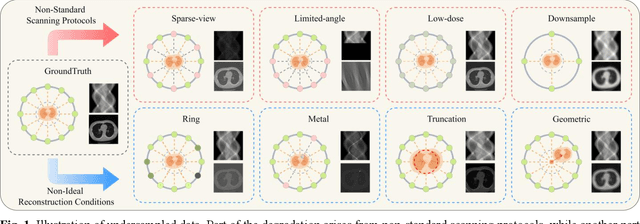
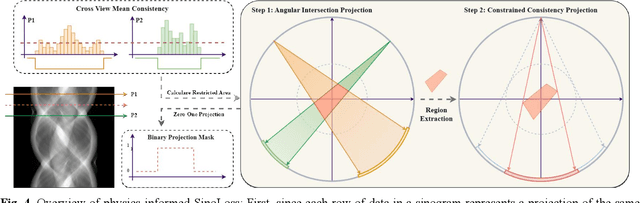
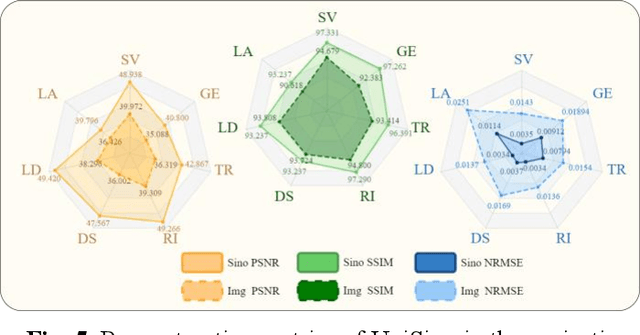
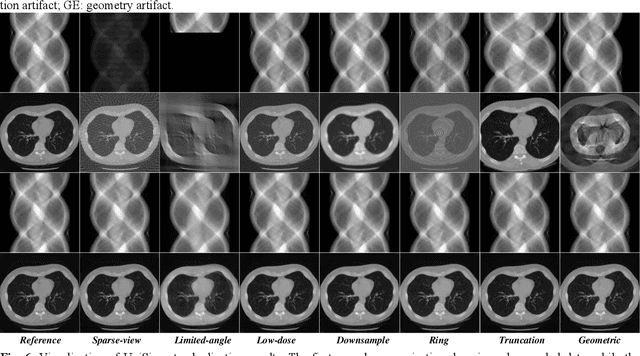
During raw-data acquisition in CT imaging, diverse factors can degrade the collected sinograms, with undersampling and noise leading to severe artifacts and noise in reconstructed images and compromising diagnostic accuracy. Conventional correction methods rely on manually designed algorithms or fixed empirical parameters, but these approaches often lack generalizability across heterogeneous artifact types. To address these limitations, we propose UniSino, a foundation model for universal CT sinogram standardization. Unlike existing foundational models that operate in image domain, UniSino directly standardizes data in the projection domain, which enables stronger generalization across diverse undersampling scenarios. Its training framework incorporates the physical characteristics of sinograms, enhancing generalization and enabling robust performance across multiple subtasks spanning four benchmark datasets. Experimental results demonstrate thatUniSino achieves superior reconstruction quality both single and mixed undersampling case, demonstrating exceptional robustness and generalization in sinogram enhancement for CT imaging. The code is available at: https://github.com/yqx7150/UniSino.
An Inclusive Foundation Model for Generalizable Cytogenetics in Precision Oncology
May 21, 2025Chromosome analysis is vital for diagnosing genetic disorders and guiding cancer therapy decisions through the identification of somatic clonal aberrations. However, developing an AI model are hindered by the overwhelming complexity and diversity of chromosomal abnormalities, requiring extensive annotation efforts, while automated methods remain task-specific and lack generalizability due to the scarcity of comprehensive datasets spanning diverse resource conditions. Here, we introduce CHROMA, a foundation model for cytogenomics, designed to overcome these challenges by learning generalizable representations of chromosomal abnormalities. Pre-trained on over 84,000 specimens (~4 million chromosomal images) via self-supervised learning, CHROMA outperforms other methods across all types of abnormalities, even when trained on fewer labelled data and more imbalanced datasets. By facilitating comprehensive mapping of instability and clonal leisons across various aberration types, CHROMA offers a scalable and generalizable solution for reliable and automated clinical analysis, reducing the annotation workload for experts and advancing precision oncology through the early detection of rare genomic abnormalities, enabling broad clinical AI applications and making advanced genomic analysis more accessible.
Generally-Occurring Model Change for Robust Counterfactual Explanations
Jul 16, 2024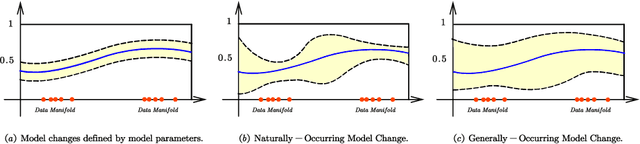
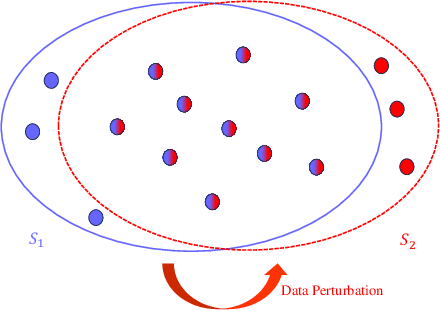
With the increasing impact of algorithmic decision-making on human lives, the interpretability of models has become a critical issue in machine learning. Counterfactual explanation is an important method in the field of interpretable machine learning, which can not only help users understand why machine learning models make specific decisions, but also help users understand how to change these decisions. Naturally, it is an important task to study the robustness of counterfactual explanation generation algorithms to model changes. Previous literature has proposed the concept of Naturally-Occurring Model Change, which has given us a deeper understanding of robustness to model change. In this paper, we first further generalize the concept of Naturally-Occurring Model Change, proposing a more general concept of model parameter changes, Generally-Occurring Model Change, which has a wider range of applicability. We also prove the corresponding probabilistic guarantees. In addition, we consider a more specific problem, data set perturbation, and give relevant theoretical results by combining optimization theory.